
Member Suggested Groups
Community members can now add or suggest groups, depending on the community’s settings. This gives members more autonomy to shape and grow their community while admins stay in control. More relevant groups help communities reach the four-subgroup goal for thriving communities, and admin approval helps keep new groups aligned with the community’s purpose.
IMPACT
2x daily thriving growth
NEW THRIVING COMMUNITIES GREW FROM ABOUT 1.3K TO 2.6K A DAY.
20K groups/day
SUBGROUPS CREATED BY MEMBERS EACH DAY.
+8% senders
8% MORE MEMBERS SENT MESSAGES, AND TOTAL MESSAGES SENT ROSE 7%, WITHIN THREE WEEKS OF A COMMUNITY APPROVING A SUGGESTED GROUP.
54K incremental
ADDITIONAL THRIVING COMMUNITIES FROM NEW GROUP SUGGESTIONS IN H2 2023.
RESULT
Member-added groups were nearly 2x as likely to get early engagement as admin-created ones. They had 59% descriptions vs. 36% for admin-created groups, generated 33% fewer mutes, and tracked to 2–3x the projected impact.
PEOPLE
PROBLEM
Only admins could add groups to a community. Just 3.5% of community groups had subgroups, and only 5.3% of admins had created them. That left many communities with very few groups, making it harder for members to see what Communities was for and for the product to find market fit.
To start a new group, members had to message a community admin and ask them to create it. To add an existing group, they had to invite a community admin into that chat first. Both workarounds added steps and left members dependent on an admin.
Members want a voice, but everyone expects the community admin(s) to stay in control.
UXR INSIGHT
Participants, admins and members alike, said community admins must approve every suggested group. “When other members can add new groups, it will be a real mess.”
Admins want to grow their group, but don’t always have a good sense or idea how to.
CONTEXT
Admins dropped off at every step of group creation, and earlier prompts to create subgroups did little to help. We shifted to a member-led approach by letting members add or suggest groups themselves.
Members think about groups that already exist first.
UXR INSIGHT
When we described “suggesting groups” in our research study, participants assumed we meant existing groups, not new ones. That showed us we needed to support suggestions for existing groups.
RESEARCH
I partnered with UX research on a remote study with 30 people in India and Brazil, including community admins and members across student, workplace, professional, hobby and friend communities. The study helped shape the design before we built it.
Leadership favored letting members add groups directly to help more communities thrive, a key measure of product-market fit. I advocated for starting with a stricter admin approval model so communities could grow while protecting members’ privacy and safety. In my previous Integrity work, I saw bad actors infiltrate groups and undermine trust. I was concerned that opening group additions too quickly could put that trust at risk and slow adoption. In the study, both admins and members expected approval, even in small, trusted communities.
“We have 5000+ people in my company so if everyone can add groups it will create a mess.” — Community member
“I still feel that new groups should be under admins’ control because that’s what the admin is for.” — Community admin
BUSINESS
OPPORTUNITY
How might we let members shape their community’s structure without undermining admin control?
Member Suggested Groups can bridge that gap by:
Breaking the growth ceilingLetting members add groups means more communities reach the thriving bar of 4+ subgroups, without relying solely on community admins to grow the community.
Bringing existing activity inLinking groups that already exist brings their members and conversations with them: no cold start, and an organic flywheel as new members add more groups.
MILESTONES
-
M1
Members add groups directly
Added a community setting that lets any member add groups directly without approval. Previously, only community admins could add groups.
-
M2
Suggesting new groups
Members could suggest new groups for admins to approve.
-
M3
Suggesting existing groups
Members could use the same review and approval process to link existing groups. This helped another 15–20K communities reach the thriving threshold.
SOLUTION
MEMBER EXPERIENCEAdding/Suggesting a Group
Based on the community setting, members can either directly add or suggest groups (new or existing ones). All suggested groups end up in a pending queue for community admins to review, while the member can remove their suggestion at any time.
Suggesting a new group
DESIGN CONSIDERATION
When a community member goes to add a new or existing group, we surface a disclaimer explaining the community’s setting—whether members can add groups directly or suggest them and wait for admin approval.
Suggesting an existing group
DESIGN CONSIDERATION
Members can also suggest an existing group, bringing its members into the community. This helps communities grow with groups that already have active conversations.
Community setting (admins only)
DESIGN CONSIDERATION
Admins can change this setting at any time to manage how their community grows.
New communities default to “Only admins,” so members can suggest groups for approval and admins decide what gets added from day one.
ADMIN EXPERIENCEReviewing groups from members
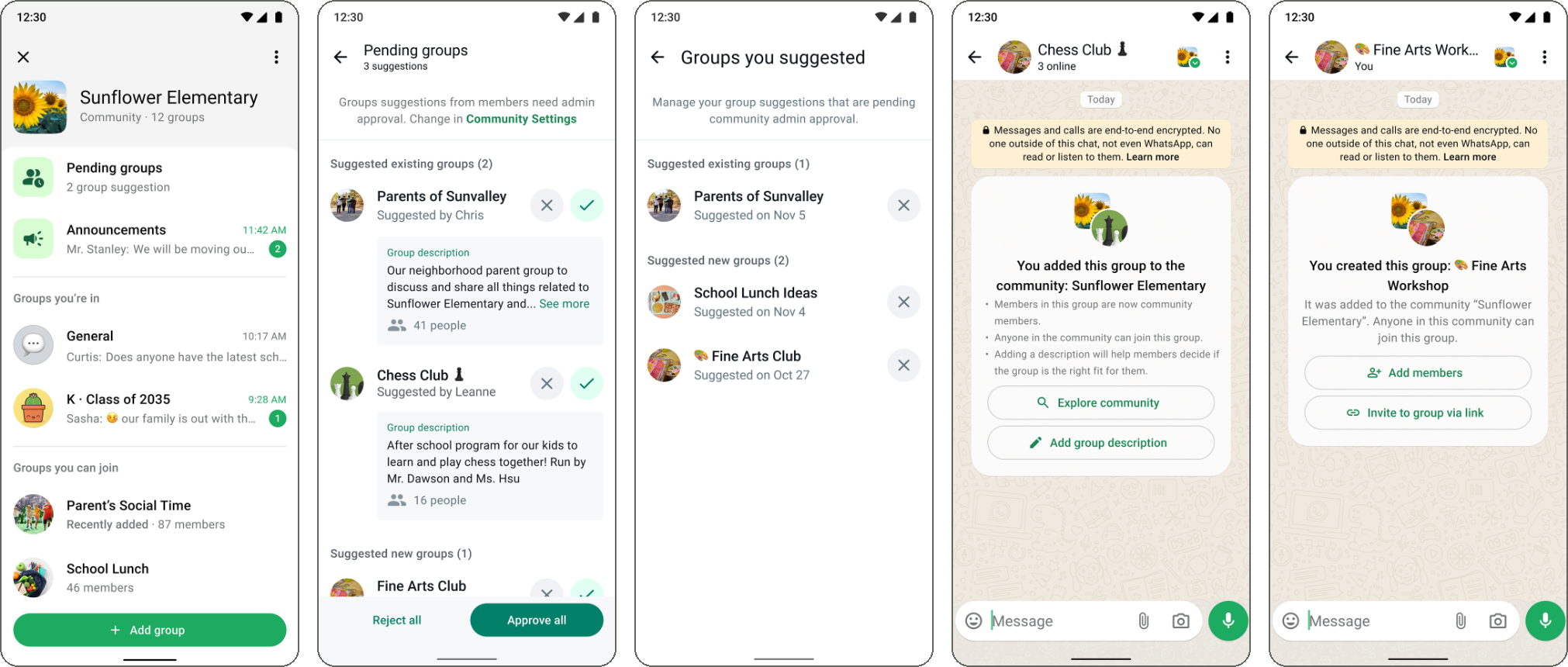
Suggested groups were new to admins, who were initially unsure what a suggestion meant and how to review it. Slow reviews could stall a group before it got started. I designed a queue that kept suggestions in one place and gave admins enough context to decide which groups fit their community.
Reviewing groups
DESIGN CONSIDERATION
Admins wanted more context before deciding whether to approve a suggestion. We required a description when creating a community subgroup. The queue showed who suggested each group, its description, its size, and any overlap with the community, such as mutual members.
I added “Approve all” and “Reject all” so admins of larger communities could act on multiple suggestions at once. These bulk actions would also lay the groundwork for potential future features like filters.
Admin awareness


DESIGN CONSIDERATION
Originally, a sticky banner in CAG was the primary entry point. I recommended push notifications and designed a Pending groups entry point that looked like a familiar chat row in the Community home (C-Nav). Its subtitle showed the number of suggestions, and the badge appeared only when new suggestions arrived.
Newly added/linked group


DESIGN CONSIDERATION
After a group is created or linked, the group context card confirms that it’s part of the community and explains what that means for members; alongside my content designer, I worked with our Integrity & Privacy teams to land on the right language.
RESULT
Within 3 weeks of approving a suggested group, active threads per day rose +96%, chats active per user +21.3% and time spent +5.8%.
84% of approved groups saw early activity, while admins reviewed 43% of suggestions. That made getting more suggestions reviewed a clear next step.
KEY PRODUCT
DECISIONS
Keep admins in control as communities grow
I advocated for starting with a stricter admin approval model so members could help grow their communities while admins decided which groups to add. My previous Integrity work showed how quickly bad actors could undermine trust by infiltrating groups. Giving admins a chance to review suggestions helped protect members’ privacy and gave admins more control over how their communities grew.
Admins as members, not co-admins
Research split on whether approving a group should make the community admin an admin of it too. We wanted to balance respecting each group creator’s autonomy with giving community admins a way to manage the broader community. Members who suggest a group own it; admins act as gatekeepers at the community level, not micro-managers of every group.
Bringing existing groups in
Research showed members thought of existing groups first. I advocated for shipping new groups first in M2 to establish the suggest → review → approve pattern, then extended it to linking existing groups in M3.
Linking existing groups added thousands more thriving communities, many of them reaching that bar the same day a group was linked.